A market multiple is a useful starting point. The harder work is establishing which market a business belongs in and what a particular buyer can do with it.
By Dr Daniel Baade | Chief Executive Officer, Dyer Baade & Company | 6 min read
An owner who has spent twenty years building a wealth management business is entitled to expect a reasonably clear answer to the question of its value. The difficulty is that the apparently clear answers are often the least useful. A multiple heard at an industry dinner, the price reported for a national group and an unsolicited offer from a consolidator may all describe quite different economics.
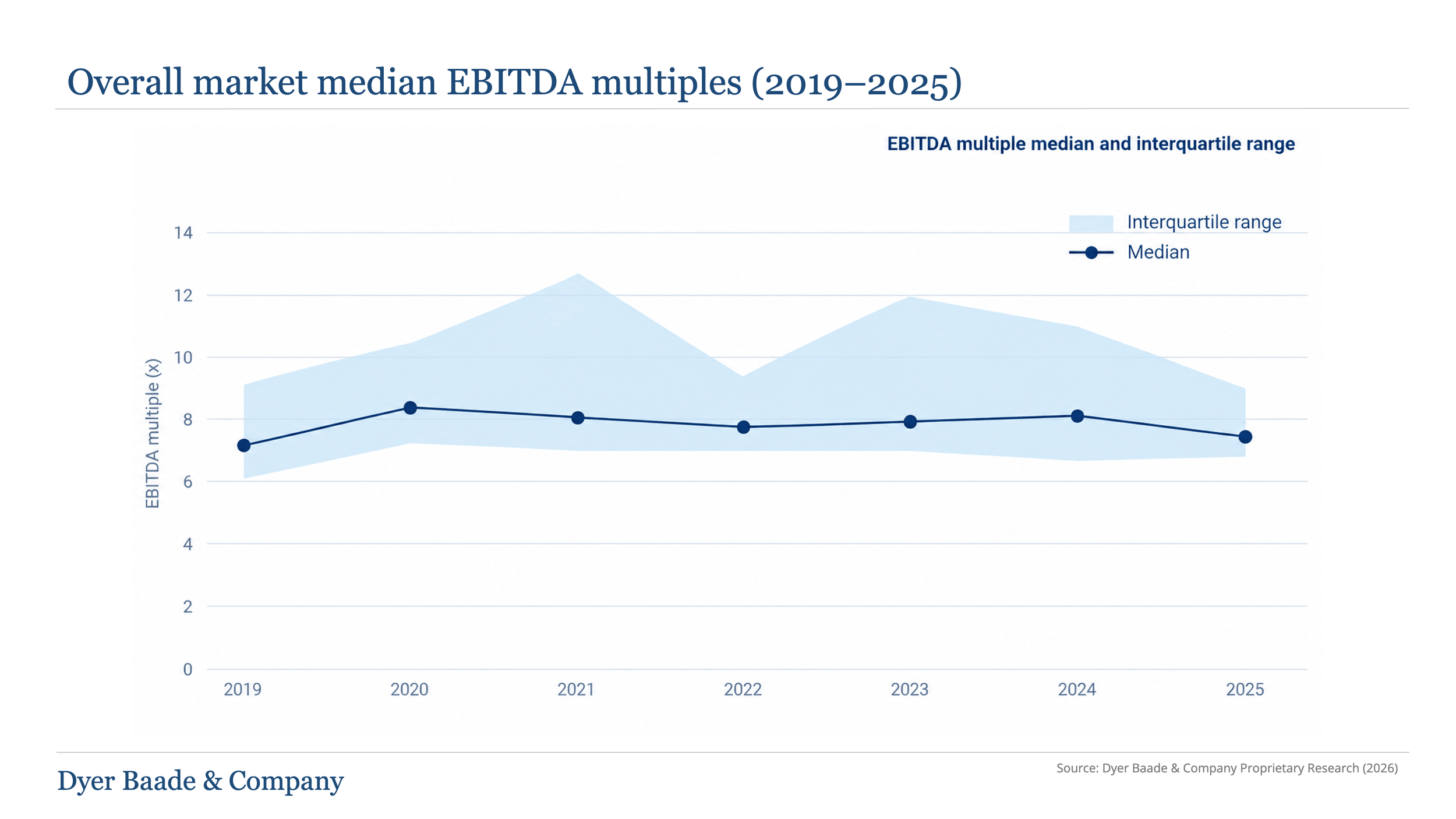
Dyer Baade’s research offers a starting point. Across 382 UK wealth management transactions between 2019 and 2025, excluding outliers, the overall median valuation was 7.8 times EBITDA. Annual medians during 2021–2025 remained between 7.4 and 8.0 times. On that evidence, the increase in acquisition activity has not produced a comparable rise in the market-wide median multiple.
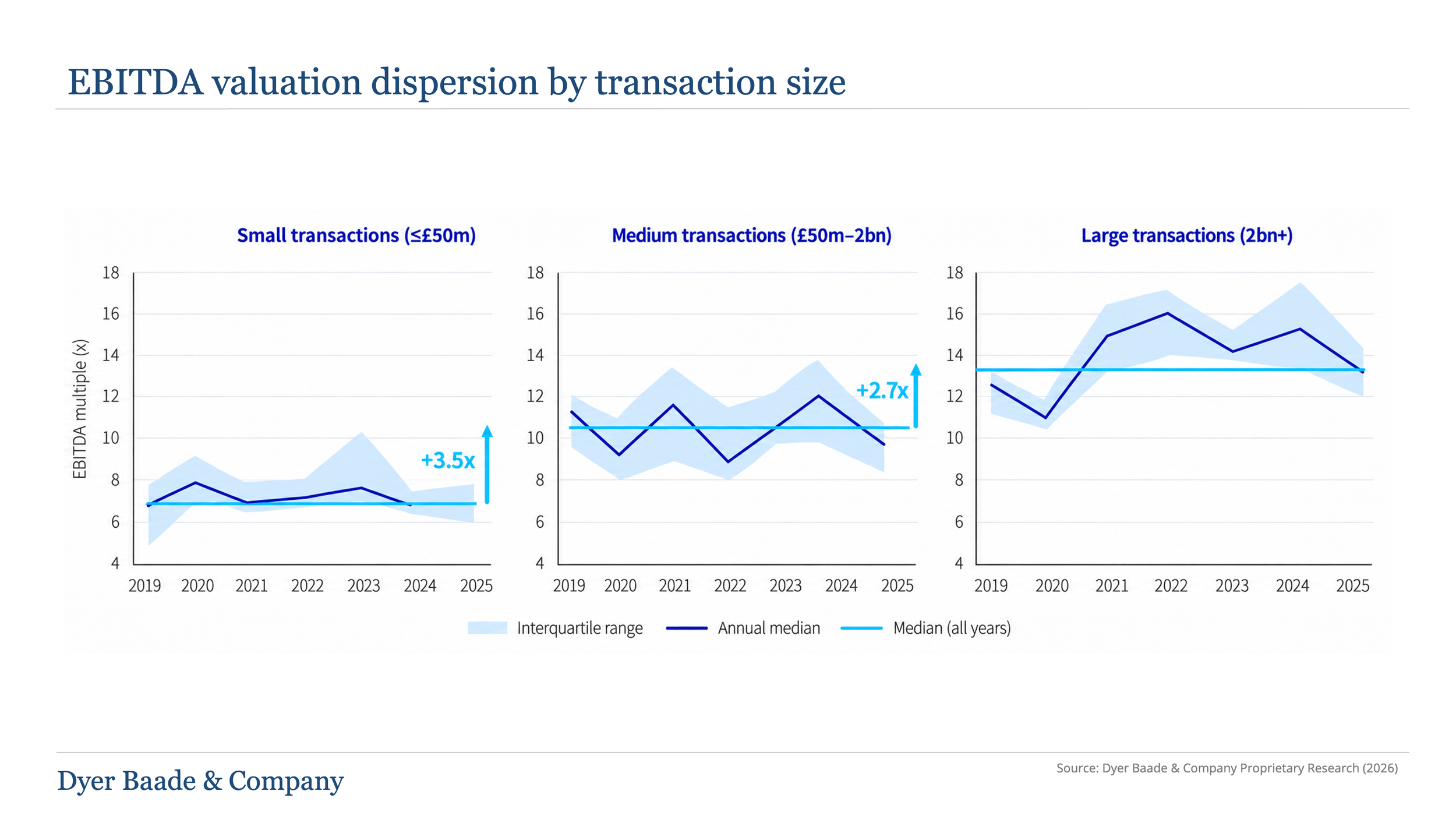
For the owner of a substantial independent business, however, stopping there would be a mistake. Within the same research, approximate segment medians were 7.0 times EBITDA for businesses with up to £500m of client assets, 10.5 times for those above £500m and up to £2bn, and 13.2 times for those above £2bn. The size bands refer to client assets, using assets under management, advice or administration as reported, rather than transaction values. These findings, examined in our UK Wealth Management M&A research, explain why a single sector multiple can be a poor guide to an individual company.
The figures require sensible interpretation. Private transaction disclosure is incomplete, so the research combines disclosed, derived and estimated valuations. It is a set of market reference points, not a continuously observable pricing index. The segment medians are also separate observations: an owner cannot start with 7.8 times and simply add a standard premium for size. Nor does crossing £2bn of client assets automatically reprice a business.
What size can change is the range of things an acquirer is buying. A smaller advice firm may bring valuable relationships and earnings that an established group can absorb into its existing infrastructure. A more developed business may also bring a management team, a regional franchise, recruitment capability and systems that can support further expansion. Those capabilities take time and money to build. Where they are demonstrably effective, a buyer may be willing to pay to acquire them.
Yet assets alone reveal surprisingly little about the quality of those capabilities. Two firms with £1bn under advice can have markedly different revenue yields, service commitments and costs. One may have a broad base of advisers generating new business; another may depend on a founder whose relationships account for much of its growth. Even the same reported EBITDA can conceal different requirements for reinvestment. A high current margin achieved by postponing essential expenditure is unlikely to carry the same value as a margin supported by an efficient, properly resourced operation.
This is where valuation discussions should become more specific. What proportion of asset growth comes from new client money rather than investment markets? How much revenue leaves through withdrawals and client losses? Can the company recruit advisers productively, and how long does it take them to contribute? A buyer needs to understand whether the earnings acquired today can grow without requiring a succession of further purchases. A seller who can answer those questions with consistent records has a stronger case than one relying on a description of the business as high quality.
The earnings number itself deserves as much attention as the multiple. Removing an exceptional expense may be reasonable; assuming that a recurring central function can disappear requires a different argument. Owner remuneration needs to be assessed against the cost of the role that will remain. Investment needed to support growth should be distinguished from expenditure that a buyer can genuinely avoid. Disagreement over sustainable EBITDA can matter as much as disagreement over price, particularly where an attractive headline multiple is applied to a heavily reduced earnings base.
For buyers, this creates a choice that cannot be settled by comparing entry multiples alone. Buying a less developed company cheaply may leave the investor funding management appointments, reporting improvements and an acquisition function before the growth plan can begin. A stronger platform may cost more but bring forward the point at which additional capital can be deployed effectively. Neither approach is inherently superior. The relevant comparison includes the expenditure, time and execution risk required after completion, as well as the acquisition price.
Strategic acquirers face a related calculation. A business that fills a geographic gap, brings a specialist client proposition or supplies management for a new region may have different value to different bidders. Cost savings can often be estimated relatively directly. Revenue benefits require more care: client suitability, adviser support and the practical ability to introduce a different service all matter. A model that assumes immediate migration of client assets into the buyer’s investment proposition can overstate both the speed and certainty of the benefit.
Recognising these differences is central to advising on wealth management transactions. A credible valuation case explains what a business already earns, what it needs to sustain those earnings and which counterparties have a reason to value its particular capabilities. Competitive tension becomes more useful when several buyers can see a concrete investment case. Sending the same materials to a long list of names does not, by itself, create that situation.
For an owner considering a transaction in eighteen months or two years, the practical implication is encouraging. There is time to improve the evidence. A management appointment can become a demonstrated succession arrangement. Better reporting can develop into a reliable history of organic flows and adviser performance. An acquisition can be integrated sufficiently for buyers to assess the result. These improvements may also strengthen the case for remaining independent, which is valuable in its own right and makes a transaction less dependent on an arbitrary deadline.
Finally, enterprise value is not the same as money available to shareholders. Debt and the agreed treatment of cash affect proceeds. Deferred payments postpone receipt, earn-outs make part of the price conditional on future performance, and retained equity leaves capital exposed to another ownership period. An offer with the highest stated multiple may therefore provide less immediate liquidity or require the seller to accept more risk. Those differences should be compared before the headline number becomes the measure of success.
For a good wealth manager, a defensible valuation is a range supported by an explanation of why particular buyers could pay within it. The most productive early discussion is therefore about the evidence behind that range: what is already established, what remains dependent on the founder and what could be strengthened before approaching the market. A company’s assets help identify the comparison group. Its earnings, capabilities and relevance to the next owner determine how convincing the valuation case will be.
These valuation considerations also inform our work as specialist Wealth Management M&A advisers, particularly when preparing a business for a potential sale or investment.
About the author
Dr Daniel Baade is Chief Executive Officer and Co-Founder of Dyer Baade & Company. He advises founders, boards and private equity investors on sales, investments and acquisitions across Wealth & Asset Management. His work combines transaction execution with proprietary research into valuations, buyer behaviour and ownership. He works with clients from early consideration of their strategic options through preparation, negotiation and completion. Transactions he advised on include amongst others: Lockhart Capital Management’s minority investment from Northcote Equity, Aberdeen’s sale to Ascot Lloyd, Kestrel Capital’s sale to IK Partners and Amicus’s sale to 7IM.
Continue the conversation
If you are assessing a valuation, a potential acquisition or the merits of remaining independent, an early discussion can help establish the relevant benchmarks and the evidence that matters for your business. Discuss valuation and your strategic options