Personal authority often helps build a successful wealth management firm. Transferring that authority gradually can preserve what makes the business valuable while giving its owner more choices.
By Dr Daniel Baade | Chief Executive Officer, Dyer Baade & Company | 6 min read
A founder’s importance is usually a source of pride, and often with good reason. Clients trust their judgement. Advisers seek their guidance. Professional contacts introduce opportunities because of the relationship they have built over decades. Those qualities can explain much of a wealth management company’s success. Yet the same strengths can raise a difficult question for a prospective investor: how much of the business will continue to function as effectively when the founder is no longer involved in every important decision?
The issue is not whether the founder should leave. Many owners want to remain for years after a transaction, and buyers may welcome that commitment. The question is whether the company has become an organisation capable of sustaining its relationships and performance beyond one person. A business can depend on its founder for leadership without depending on them for every client escalation, recruitment decision, commercial introduction and operational judgement. The distinction affects succession, ownership options and the risks a buyer must assess.
A useful test is to consider an extended absence. If the founder were unavailable for three months, what would stop, slow down or become uncertain? The answer may reveal dependencies that the organisation chart does not show. A senior management team can exist while important decisions still wait for informal approval. Client relationships can be allocated to advisers while clients continue to expect access to the founder. Finance and operations can be professionally managed while commercial knowledge remains concentrated in one person’s memory.
These are different problems and require different responses. Decision-making dependence calls for genuine authority and clear accountability. Client dependence requires a careful transfer of confidence, usually through shared relationships over time. Commercial dependence may require others to develop referral networks or lead important negotiations. Knowledge dependence can involve better records and processes, but documentation alone is unlikely to replace judgement. Treating founder dependence as a single issue to be solved by appointing a chief operating officer often misses the underlying detail.
The discussion should include incentives for the people expected to assume more responsibility. A successor asked to protect client relationships and lead growth will want clarity about authority, recognition and future opportunity. If those arrangements remain uncertain, the company risks developing capable people without giving them a compelling reason to stay. Retention and succession need to be considered together.
For owners of sizeable privately held firms, the difficulty is frequently emotional as well as practical. Delegating a responsibility means accepting that someone else may perform it differently. The founder may also remain the person most capable of resolving a difficult situation quickly. Repeatedly stepping back in can nevertheless prevent successors from building confidence and credibility. The objective is not withdrawal for its own sake. It is to establish which matters genuinely require the founder’s involvement and allow the organisation to handle the rest.
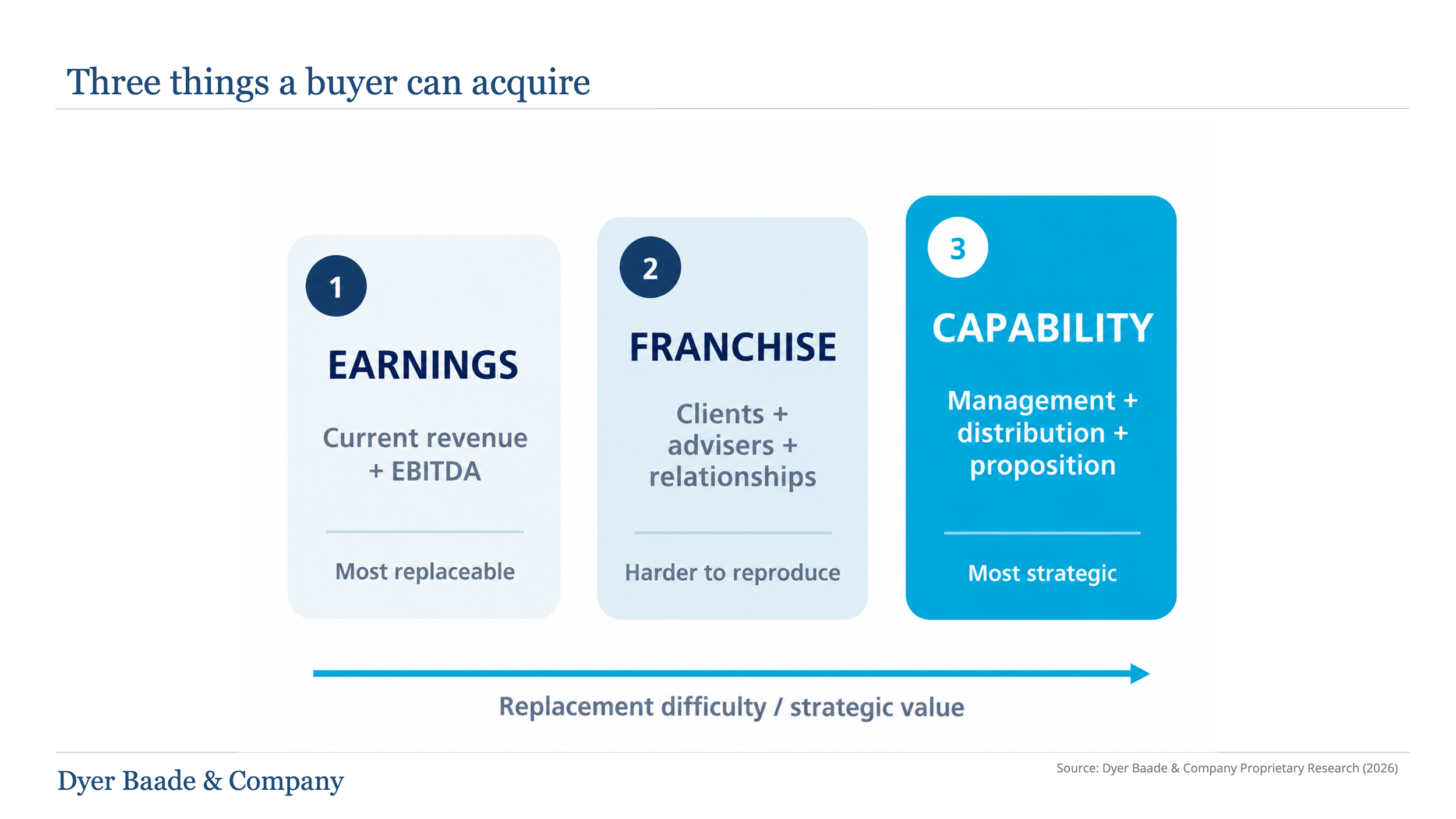
Our wealth management research identifies management depth as an important component of business quality. Buyers need to see that depth operating, rather than simply named in a presentation. Evidence might include a management team delivering a budget, leading recruitment, managing a systems change or retaining clients through a transition. These examples show how responsibility is distributed in practice. A newly revised organisation chart prepared immediately before a sale offers much less assurance, even where the proposed arrangements are sensible.
The implications for a transaction extend beyond valuation. A buyer concerned about founder dependence may seek a longer continuing role, deferred consideration linked to performance or stronger retention arrangements. It may also budget for additional management, affecting its view of sustainable earnings. None of these outcomes follows automatically, and founder-led companies can achieve excellent transactions. But an owner seeking both maximum immediate liquidity and a rapid departure should understand the tension if the business still relies heavily on their daily contribution.
For the buyer, founder involvement can be an asset rather than a problem to eliminate. The founder may retain valuable client insight, cultural authority and commercial ambition. A good ownership arrangement makes constructive use of those strengths while developing the wider organisation. An ill-defined role can do the opposite: management is unsure who decides, the founder feels marginalised and the buyer assumes responsibilities have transferred when they have not. The transition plan deserves attention alongside the acquisition structure, particularly where the founder retains equity.
Private equity investors considering a platform need to assess both the existing leadership and the next layer. A founder may be well suited to lead the current business but need support to manage a larger group. Alternatively, an experienced team may already be capable of taking more responsibility than the founder has allowed. The investor’s task is to understand the gap and agree a realistic development plan. Replacing the founder too quickly can put relationships at risk; leaving every dependency untouched can constrain the growth strategy.
Professional investors approaching an exit should examine the same issue early in the ownership period. A management succession plan that becomes urgent shortly before a sale may narrow options and distract from preparation. Developing credible leaders takes time, and buyers will want evidence that the arrangement works. The benefit is not limited to exit readiness. A less concentrated organisation can absorb acquisitions, respond to problems and pursue new opportunities without repeatedly drawing on the same individual. It can also make key management roles more attractive to ambitious people.
For a founder who may transact in eighteen months or two years, the most useful first step is a candid assessment of responsibilities and relationships. Identify the few dependencies that would most concern a successor, investor or buyer, then work on them deliberately. In wealth management M&A advice, this is part of understanding the owner’s intended future role rather than imposing a standard retirement plan. The preparation should fit what the shareholder actually wants, whether that is a full exit, a continuing leadership position or greater freedom within an independent business.
A company does not become less distinctive because more people can lead it. Done well, succession preserves the founder’s standards by making them part of the organisation rather than a service only the founder can provide. Clients receive continuity, employees see a future and owners gain more credible choices. The strongest evidence of a founder’s achievement may ultimately be that the business can continue to prosper without needing them to resolve every important question.
About the author
Dr Daniel Baade is Chief Executive Officer and Co-Founder of Dyer Baade & Company. He advises founders, boards and private equity investors on sales, investments and acquisitions across Wealth & Asset Management. His work combines transaction execution with proprietary research into valuations, buyer behaviour and ownership. He works with clients from early consideration of their strategic options through preparation, negotiation and completion.
Continue the conversation
If you are considering succession, a partner or a future exit, we would be pleased to discuss how your preferred role and the management structure affect the options available. Discuss succession and your future role