Strategic value is specific to the buyer. The challenge is to identify an advantage that matters, establish why it is difficult to reproduce and show that it will survive a transaction.
By Dr Daniel Baade | Chief Executive Officer, Dyer Baade & Company | 6 min read
The same wealth management company can solve very different problems for different buyers. One sees another source of recurring earnings. Another sees an experienced regional management team. A third sees access to a client group it has struggled to reach. Their financial models may begin with the same accounts, but the strategic value they attach to ownership can differ substantially. For a seller, understanding those differences can be more valuable than refining a generic description of why the business is high quality.
Scarcity is often invoked too loosely in sale materials. Almost every company is described as differentiated, and many have strengths that management quite reasonably values. But a characteristic becomes strategically scarce only in relation to a buyer’s alternatives. Can the buyer recruit a comparable team? Build the capability internally? Acquire another business with similar attributes? If the answer is yes, at an acceptable cost and within a reasonable period, the target’s negotiating position may be weaker than its presentation suggests.
Time can be an important part of the answer. A regional presence, professional referral network or trusted client franchise may take years to establish. Acquiring it can accelerate a strategy, provided the relationships remain intact after completion. A buyer may also gain management capable of leading further expansion, avoiding a lengthy recruitment and development process. These advantages are not captured fully by current earnings. They can influence valuation where the buyer has a credible plan to use them and sufficient conviction to pay for the opportunity.
The distinction appears throughout our research on wealth management valuation. Business size affects the relevant benchmark, but size alone does not establish why a particular purchaser should pay a premium. A larger company may offer infrastructure, distribution and leadership that smaller targets lack. Equally, it may duplicate capabilities the buyer already has. The investment case needs to identify what is additional and useful to that buyer, rather than assuming that every component of the target carries the same strategic value for everyone.
For an owner, this calls for a more demanding preparation exercise. It is not enough to state that the company has a strong team. Which responsibilities can that team assume within a larger group? Has it managed expansion successfully? Will its members remain? A geographic footprint should be assessed in terms of client access, adviser capacity and local leadership, not simply office locations. A client specialism should be supported by evidence of retention, referral patterns and service capability. Specific evidence makes a strategic argument investable.
The value of an attribute can also change as a buyer develops. A capability that was missing two years ago may now have been built or acquired elsewhere. Conversely, a change in strategy can make a previously peripheral target important. Buyer analysis should therefore be refreshed as a process approaches, rather than relying on a historic reputation for paying well in the sector.
Transferability is crucial. Some of the attributes that make a founder’s company distinctive may depend heavily on that founder’s relationships or personal involvement. A buyer could value them highly while doubting how much will survive a change of ownership. Others may depend on a culture or proposition that the buyer intends to alter. The strategic case should confront that tension. If integration removes the characteristics that justified the premium, the acquirer may destroy part of the value it believed it was buying.
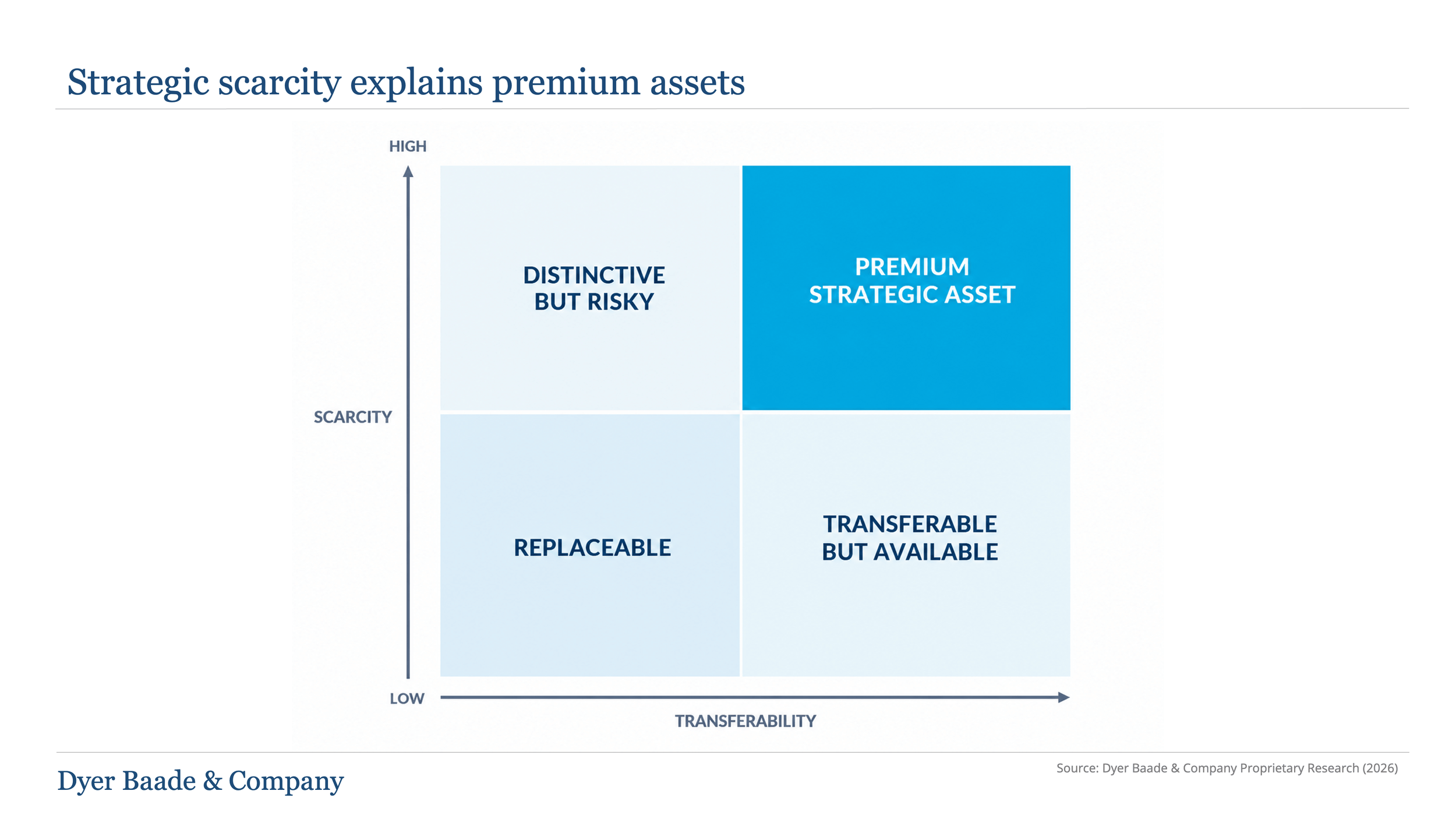
This is equally a question for buyers. Before pursuing a strategically important target, management should articulate the benefit, the conditions required to achieve it and the alternatives if the transaction does not happen. That discipline helps distinguish genuine strategic value from enthusiasm generated by a competitive process. A target may be rare without being essential. Another may be expensive on a standalone earnings measure but attractive once specific, achievable benefits are considered. The task is to quantify what can reasonably be quantified and make the remaining assumptions explicit.
Private equity entrants should be especially careful when comparing their valuation with that of an established operating group. The latter may possess infrastructure that allows it to realise benefits more quickly. A new sponsor may instead offer the management team greater scope to lead a standalone growth strategy. These are different propositions, with different costs and potential returns. A fund should not assume it must match a strategic buyer’s economics to remain competitive. It needs to understand whether its ownership model offers something the shareholders value sufficiently to influence the decision.
A strong strategic rationale does not automatically produce the highest offer. The buyer may lack funding, face internal approval constraints or believe the seller has few alternatives. It may also retain more of the expected benefit in its own return calculation. Sellers therefore need both a persuasive investment case and credible competition. Identifying the most natural acquirer is a starting point, not a reason to rely on that organisation alone. The strongest process tests whether other counterparties attach value to different aspects of the business.
Nor should owners equate the highest strategic valuation with the best overall outcome. A purchaser expecting substantial integration benefits may require changes to brand, systems or management responsibilities. Another may pay slightly less while preserving an ownership role or providing a more attractive continuing investment. The economics and the future operating arrangements should be compared together. Shareholders need to understand what each bidder is buying, what it intends to change and how those intentions affect the people and relationships that underpin the business.
This analysis is useful long before a sale. A founder may discover that management depth would materially broaden the buyer universe, or that a particular distribution capability would strengthen both independence and strategic relevance. A sponsor may identify the characteristics most likely to appeal to the next owner and invest in proving them during the hold period. In wealth management M&A, early strategic work can inform operating decisions rather than merely the wording of an eventual sale document.
The objective is not to manufacture a story around an ordinary business. It is to understand the company accurately and identify where its existing strengths, or improvements it can credibly make, have unusual value. A buyer’s willingness to pay ultimately rests on the opportunity it believes ownership creates. The seller’s position is strongest when that opportunity is supported by evidence, difficult to reproduce and understood by more than one credible counterparty. That is a firmer basis for a premium than a general claim that the market is strong.
About the author
Dr Daniel Baade is Chief Executive Officer and Co-Founder of Dyer Baade & Company. He advises founders, boards and private equity investors on sales, investments and acquisitions across Wealth & Asset Management. His work combines transaction execution with proprietary research into valuations, buyer behaviour and ownership. He works with clients from early consideration of their strategic options through preparation, negotiation and completion.
Continue the conversation
For owners considering a future transaction, or investors evaluating a strategically important target, we can help identify the capabilities that different counterparties may value and the evidence required. Discuss strategic value and potential counterparties