Types of Private Equity Explained: A Founder’s Guide to Venture Capital, Growth Equity and Buyouts

Venture capital, growth equity and buyouts can all provide businesses with capital - but they are designed for very different companies, objectives and stages of ownership.
For a founder or CEO, choosing the wrong form of capital can be expensive. It can lead to unnecessary dilution, inappropriate governance arrangements, excessive leverage or a partnership that is fundamentally misaligned with the shareholders’ objectives.
Choosing well can have the opposite effect. The right investor can provide capital, strategic expertise, acquisition support and access to networks that would be difficult to replicate independently.
The critical point is that private equity is not one product and a private-equity transaction is not always a sale.
For owners of established businesses valued between approximately £20 million and £200 million, the practical decision is rarely simply whether to “take private equity”. It is more often a choice between:
Raising capital for the company or creating liquidity for shareholders.
Selling a minority or majority interest.
Retaining operational control or beginning a gradual succession.
Using debt, equity or a combination of both.
Completing a full exit now or creating the opportunity for a larger second exit later.
Understanding these distinctions is essential before approaching investors or commencing a transaction process.
What are the main types of private equity?
In its broadest sense, private equity is medium- to long-term capital invested in privately owned companies in return for an equity interest.
The three principal strategies are:
Venture capital, which typically backs relatively young and developing businesses.
Growth equity, which invests in established companies with proven business models that require capital to accelerate expansion.
Buyout capital, which is used to acquire a majority or controlling interest in a mature business, often combining investor equity with acquisition debt.
Industry definitions distinguish growth funds - which often make minority investments in relatively mature businesses requiring expansion capital - from buyout funds, which generally acquire majority or controlling stakes using a mixture of debt and equity.

The boundaries between these categories are not absolute. A late-stage venture-capital investment may resemble growth equity, while a minority private-equity transaction may contain governance rights normally associated with control.
The name attached to the capital therefore matters less than the commercial substance of the proposed transaction.
The first question is not “Which investor?” It is “What are you trying to achieve?”
Founders frequently begin by asking which private-equity firms might invest in their business.
That question comes too early.
Before discussing individual investors, shareholders should determine what they actually want the transaction to achieve.
There are four principal objectives.
Capital for the business
The company may require funding to recruit senior executives, invest in technology, develop new products, enter new markets or complete acquisitions.
This is known as primary capital. New shares are issued and the proceeds remain in the company.
Liquidity for shareholders
A founder may wish to diversify personal wealth, reduce financial concentration or realise part of the value created over many years.
This is known as a secondary transaction. The investor purchases shares from existing shareholders and the proceeds go to those shareholders rather than to the company.
A combination of capital and liquidity
Many growth-equity and private-equity transactions contain both elements.
Part of the investment funds expansion, while another part allows the founder or other shareholders to sell some of their shares. This can be particularly attractive where the owners remain confident in the company but no longer want almost all their wealth tied to one asset.
A complete ownership transition
Some founders want to sell the entire business, step away from management and transfer responsibility to a new owner.
Others want to sell control but retain an equity interest, remain involved for several years and participate in a future increase in value.
These are materially different objectives. A transaction should be constructed around the shareholders’ desired outcome - not around whichever structure an investor initially proposes.
Venture capital: backing potential before full proof
Venture capital is principally designed for businesses at an early stage of their development.
The company may have developed a promising product, intellectual property or technology but may not yet have a fully proven revenue model, consistent profitability or predictable cash generation. The investment is therefore based heavily on the size of the potential market, the quality of the management team and the prospect of rapid growth.
Venture-capital investors generally acquire minority interests. Because many early-stage businesses fail, successful investments must have the potential to produce disproportionately large returns.
For founders, venture capital can provide essential funding where traditional debt is unavailable or inappropriate. However, it also creates dilution and often introduces a sequence of future investment rounds. The founder’s percentage ownership can therefore reduce materially over time, even when the value of the remaining interest increases.
For most established companies valued between £20 million and £200 million, conventional venture capital is unlikely to be the most relevant option. An important exception may be a technology, healthcare or life-sciences company whose valuation reflects exceptional expected growth rather than current profitability.
The central question is whether the company is still proving its model or is already scaling one that works.
Growth equity: accelerating a proven business
Growth equity occupies the space between venture capital and a conventional buyout.
It is generally invested in companies that have moved beyond the start-up stage. They have an established customer proposition, meaningful revenues, evidence of demand and a credible route to further growth.
The business may want to expand geographically, invest in additional capacity, recruit senior executives, develop new distribution channels or pursue acquisitions. The objective is not to rescue the company or reinvent its core proposition. It is to accelerate a model that is already working.
Growth-equity investors often acquire a minority interest, allowing founders to retain majority ownership. In practice, however, minority investors can still negotiate substantial governance and consent rights.
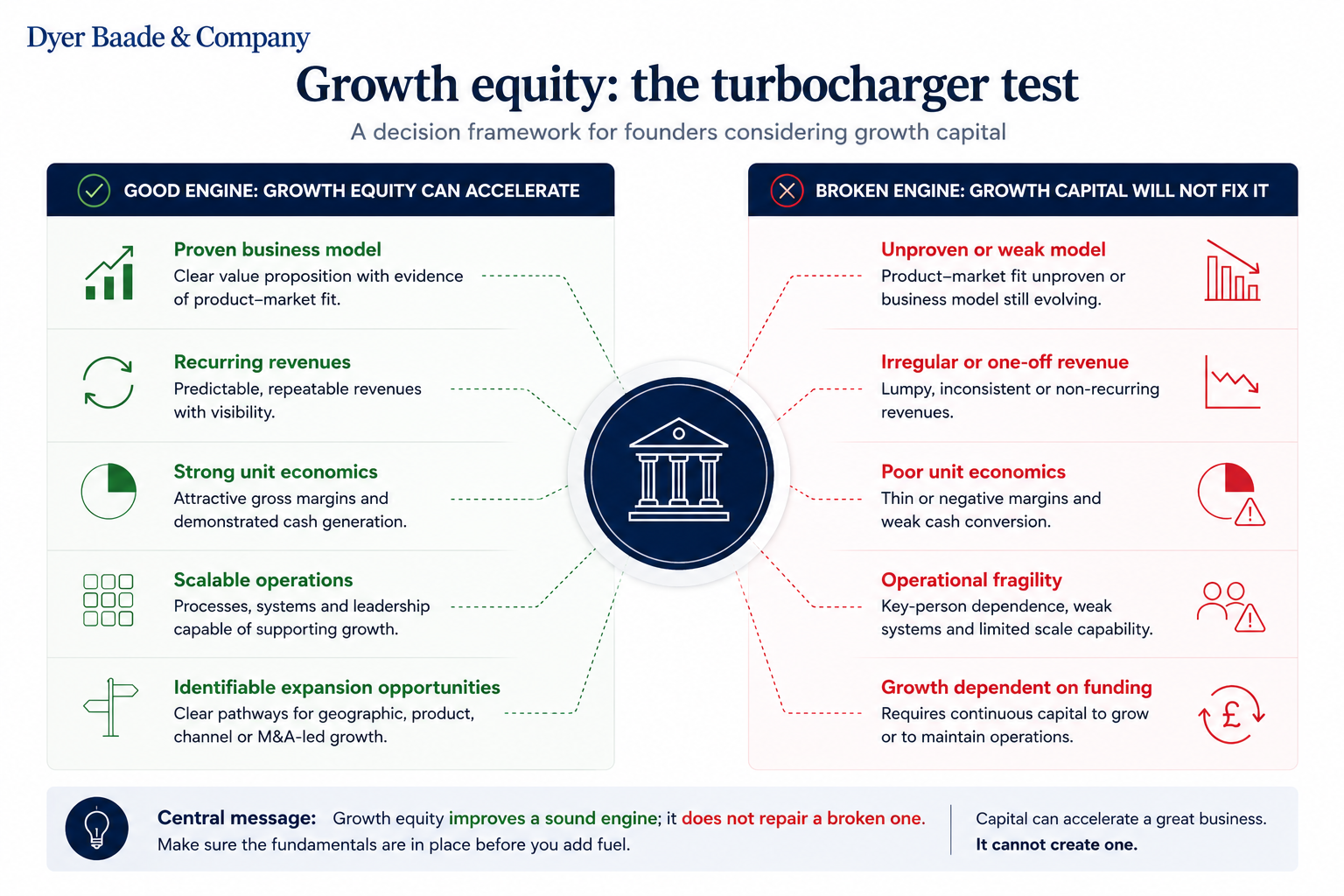
The growth-equity turbocharger test
A useful way to assess whether a company is suitable for growth equity is to ask:
Would this be a strong and attractive business without the investment - and would additional capital allow it to grow materially faster?
Where the answer is yes, growth capital may act as a turbocharger.
Where the capital is primarily required to cover recurring losses, compensate for weak financial controls or support a strategy that has not yet been proven, the investment may merely finance existing weaknesses.
Strong growth-equity candidates typically have:
A demonstrably attractive market.
A differentiated customer proposition.
Consistent organic growth.
Positive or clearly emerging profitability.
A capable management team.
Credible opportunities to deploy additional capital.
Financial and operational infrastructure capable of supporting expansion.
Growth capital is most effective where the principal constraint is speed or capacity, rather than the underlying quality of the business.
Case study: Kestrel Capital and IK Partners
Kestrel Capital demonstrates how private-equity development capital can support a proven business without ending the founder and management journey.
Kestrel had developed a differentiated wealth-management proposition in Ireland, supported by an experienced leadership team and scalable infrastructure. IK Partners agreed to invest through its Development Capital strategy alongside Kestrel’s existing owners, who continued to manage and develop the business. The transaction represented IK’s first platform investment in Ireland.
The investment was intended to support Kestrel’s next phase of development, including continued organic growth and opportunities arising from consolidation in the Irish wealth-management market.
Dyer Baade & Company acted as lead sell-side adviser to Kestrel’s shareholders. The work included developing the investment positioning, identifying a targeted universe of suitable financial sponsors, creating competitive tension and negotiating valuation and transaction structure.
The wider lesson is applicable well beyond financial services.
Growth equity works best when:
The company already has an attractive and credible strategy.
Existing management remains important to future value creation.
Capital can be deployed against identifiable opportunities.
The investor brings relevant experience in addition to funding.
The owners and investor are aligned on the next stage of the journey.
The investor should accelerate the company’s strategy - not replace the need for one.
Buyout capital: funding an ownership transition
A private-equity buyout usually involves the acquisition of a majority or controlling interest in an established company.
Unlike a venture-capital or conventional growth-equity investment, a buyout is normally intended to create meaningful liquidity for existing shareholders. Some or all of the purchase price may be financed with debt, supported by the cash flows of the acquired business.
Buyouts are commonly used where:
A founder wants to realise a substantial proportion of personal wealth.
Existing shareholders have different time horizons.
A business requires succession beyond its current ownership.
Management wants to acquire the company through a management buyout.
A corporate group wishes to sell a non-core subsidiary.
An investor sees an opportunity to create a larger platform through acquisitions.
A buyout does not necessarily require the founder to leave.
In many transactions, the founder sells a majority interest but reinvests part of the proceeds into the new ownership structure. This is generally known as rollover equity or reinvestment.
The founder receives substantial liquidity at completion while retaining the opportunity to participate in a future exit. This future transaction is sometimes described as the founder’s “second bite of the cherry”.
The potential upside can be significant, but it is not risk-free. The retained investment will normally be illiquid, subordinate to certain debt obligations and exposed to the future performance of the company.
Founders should therefore assess the first transaction and the prospective second exit separately.
Minority investment versus majority investment
The percentage of shares sold is important, but it does not by itself determine how much control the founder retains.
Minority investment
A minority transaction can allow the founder to retain more than 50% of the shares and continue leading the company.
However, institutional investors are unlikely to rely solely on their shareholding percentage for protection. They may require consent rights over matters such as:
The annual budget and business plan.
Material acquisitions or disposals.
New borrowing.
Capital expenditure above an agreed threshold.
Dividends.
Changes to senior management.
Issuing additional shares.
Related-party transactions.
A future sale or exit.
The founder may retain legal control but operate within a substantially more institutional governance framework.
Majority investment
In a majority transaction, the investor acquires control. Nevertheless, the founder may continue as chief executive, retain meaningful equity and exercise considerable influence over day-to-day operations.
Private-equity investors generally do not want to replace a high-performing management team simply because they have acquired control. Their investment case may depend heavily on the founder continuing to deliver the business plan.
The practical question is therefore not simply:
“Will I own more or less than 50%?”
It is:
“Which decisions will I be able to make independently after completion, and what will happen if the investor and I disagree?”
That answer is found in the shareholder agreement, investment agreement, articles of association and management arrangements - not in the headline ownership percentage.
Does private equity mean losing control?
Sometimes - but not always.
A full buyout transfers ownership and ultimate control. A majority investment usually gives the investor control over fundamental corporate decisions. A minority investment may leave the founder with voting control but introduce extensive reserved matters and board oversight.
Founders should review control across five dimensions:
Ownership
How much of the company will each shareholder own immediately after completion and following any future management-equity arrangements?
Board control
Who appoints directors? Does either party have a casting vote? Will an independent chair be appointed?
Reserved matters
Which decisions require investor approval, irrespective of the founder’s majority shareholding?
Management authority
Will the founder remain chief executive? How will performance be assessed? Under what circumstances can the founder be removed?
Exit rights
Can the investor require a sale after a specified period? Can the founder prevent or delay an exit? What drag-along and tag-along rights apply?
These issues should be discussed early. A high valuation does not compensate for an ownership structure that the founder will find unacceptable after completion.
The importance of management equity
Private equity seeks to align the interests of the investor and the management team.
Founders and senior executives may therefore be asked to reinvest part of their proceeds or participate in a new management-equity plan.
The value of that equity depends on more than the headline percentage. Important considerations include:
The amount and ranking of acquisition debt.
Any preference attached to the investor’s shares.
The threshold at which management equity begins to participate.
Good- and bad-leaver provisions.
Vesting arrangements.
Dilution from future acquisitions or incentive awards.
The treatment of equity if the founder is removed from management.
The investor’s assumed exit valuation.
A relatively small percentage of ordinary equity can be valuable where the capital structure is balanced and the business performs strongly.
A larger percentage can produce little value where debt, preference instruments or incentive thresholds absorb most of the proceeds.
Founders should therefore model the potential outcome under several exit scenarios rather than focus on the percentage alone.
Debt or private equity?
Equity is not always the correct answer.
A profitable company with predictable cash flows may be able to fund expansion through bank debt, private credit or an acquisition facility without diluting existing shareholders.
Debt can be attractive where:
The required investment is clearly defined.
Future cash generation should comfortably support interest and repayments.
The owners want to retain all or almost all of the equity.
The company does not require substantial strategic or operational support.
The growth plan does not involve excessive execution risk.
Equity may be more appropriate where:
The required capital is large relative to current cash flow.
The company is pursuing ambitious acquisition-led expansion.
Shareholders also want personal liquidity.
Additional expertise, governance and networks would add value.
The owners want to share risk with an institutional partner.
The company’s existing leverage is already material.
Debt and private equity should not always be viewed as competing alternatives. They can be used sequentially as the company develops.
Case study: Clifton Asset Management and CBPE
Clifton Asset Management illustrates how capital strategy can evolve over several years.
Dyer Baade advised Clifton’s shareholders for more than three years on strategic positioning, growth and capital structure. This included a substantial debt raise in 2022 to fund the company’s expansion.
As Clifton developed, its strategic ambitions and capital requirements evolved. CBPE invested in the business in 2024 to support continued organic growth and a targeted acquisition strategy.
Dyer Baade subsequently acted as exclusive financial adviser to Clifton’s shareholders, running a competitive private-equity process, developing the investment proposition and negotiating valuation and structure. Clifton’s chairman stated that the terms secured were considerably ahead of the shareholders’ initial expectations.
The case demonstrates three important principles.
First, the right source of capital can change as a company grows.
Second, taking debt at one stage does not prevent the company from raising equity later.
Third, owners who consider capital structure and strategic positioning several years before a transaction generally have more options than those who begin preparing only after receiving an unsolicited approach.
The best capital decision is often a sequence - not a single event.
For more details on how Dyer Baade supported Clifton on their exit to CBPE.
How private equity investors create value
Private-equity investors ultimately need to sell their investment for more than they paid. The investment plan will therefore be centred on increasing the value of the company during the ownership period.
Value creation typically comes from a combination of six sources.
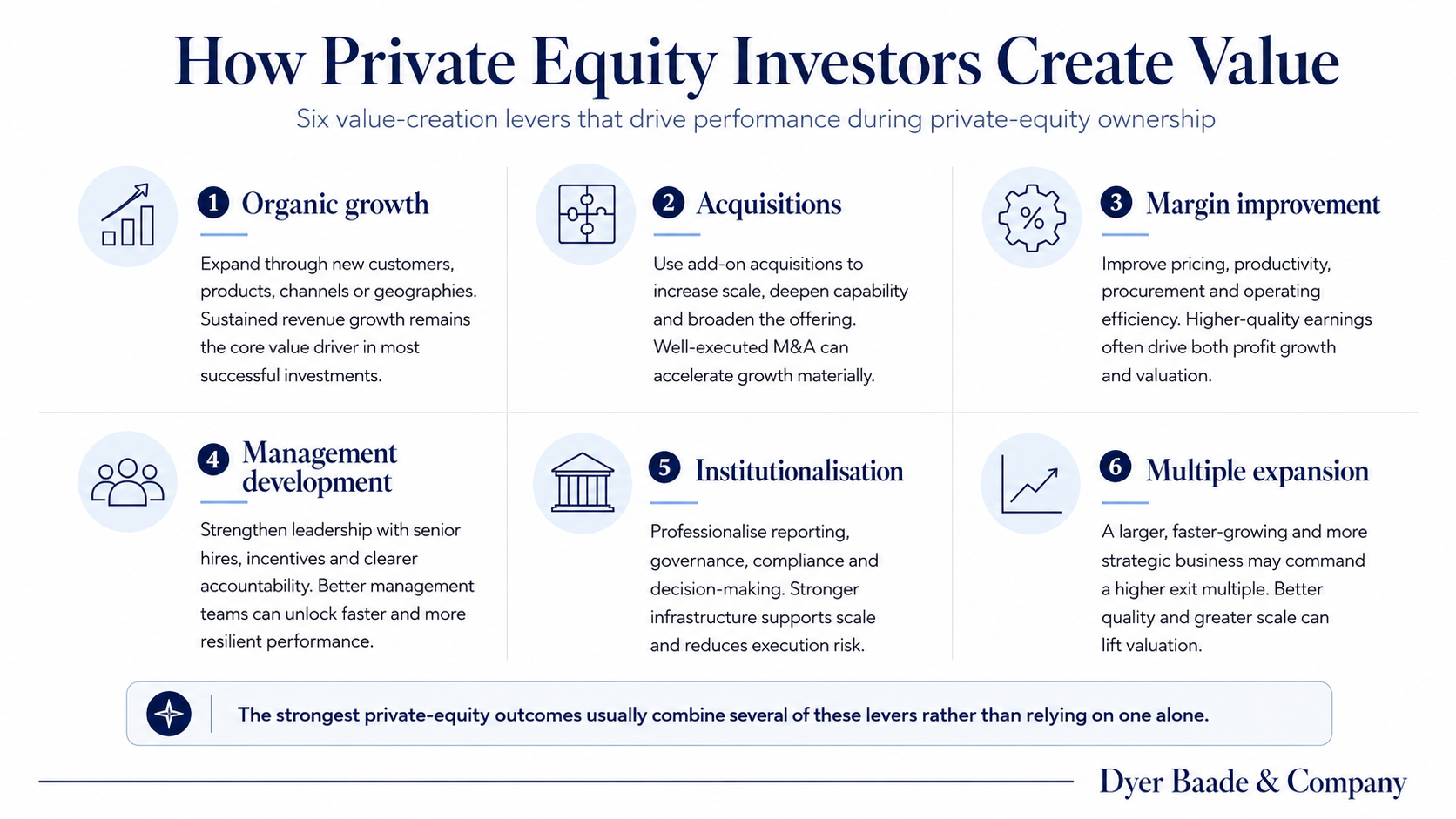
Organic growth
The company may expand through new customers, products, distribution channels or geographical markets.
Acquisitions
A platform business may acquire smaller competitors or complementary companies, increasing scale and broadening its proposition.
Margin improvement
The business may improve pricing, procurement, productivity, automation or operating efficiency.
Management development
The investor may help recruit senior executives, introduce performance incentives and strengthen the organisational structure.
Institutionalisation
Financial reporting, governance, compliance, risk management and decision-making processes may become more sophisticated.
Multiple expansion
A larger, faster-growing or more strategically attractive company may achieve a higher valuation multiple on exit than it commanded at entry.
A founder should understand precisely which of these assumptions underpin the investor’s valuation.
Where the proposed return depends on an unrealistic acquisition programme, aggressive cost reduction or substantial multiple expansion, the plan may be more fragile than the headline offer suggests.
Is private equity simply asset stripping?
The criticism that private equity investors acquire companies, increase debt, reduce costs and sell them for a short-term profit is not entirely without foundation. Some transactions have used excessive leverage or prioritised financial engineering over the long-term health of the business.
But it is not an accurate description of the entire market.
Many private-equity investors specialise in backing strong management teams, investing in capacity, funding acquisitions and professionalising businesses that could not have achieved the same rate of growth independently.
Private-equity ownership is neither inherently good nor inherently bad.
The outcome depends on:
The quality and integrity of the investor.
The appropriateness of the capital structure.
The realism of the investment plan.
The alignment between shareholders, management and investor.
The resilience of the business.
The terms negotiated before completion.
The correct question is not whether private equity is good or bad in the abstract.
It is whether a particular investor, transaction structure and value-creation plan are appropriate for this company and these shareholders.
Which type of private equity is right for your business?
For most established founder-led companies, the following framework provides a useful starting point.
Venture capital may be appropriate where:
The company remains relatively early in its development, is investing ahead of revenue and has the potential to grow at exceptional speed.
Growth equity may be appropriate where:
The business has proven its model, is growing strongly and can identify specific opportunities to deploy additional capital while the founder wants to remain substantially invested.
A minority private-equity transaction may be appropriate where:
The founder wants capital, expertise or partial liquidity but wishes to retain majority ownership and continue leading the business.
A majority investment may be appropriate where:
The founder wants to realise substantial value now, reduce personal financial exposure and share responsibility for the next stage while remaining involved.
A full buyout may be appropriate where:
The shareholders want a complete exit, the business requires new ownership or there is no desire to participate in a future transaction.
Debt may be more appropriate where:
The required capital is manageable relative to cash flow, the shareholders do not need liquidity and the company can execute its plan without an equity partner.
These are starting points rather than fixed rules. The optimal transaction may combine several elements.
How to choose the right private-equity partner
Valuation matters, but the highest initial offer is not always the best transaction.
A founder entering a multi-year partnership should assess the proposed investor across a wider set of criteria.
Relevant experience
Has the investor successfully backed businesses with similar characteristics, regulatory requirements and growth strategies?
Strategic alignment
Does the investor support the management team’s plan, or does it intend to impose a materially different strategy after completion?
Value-creation capability
Can the investor provide useful support with acquisitions, recruitment, technology, international expansion or operational improvement?
Working style
How involved will the investment team be? How does it behave when performance falls below plan?
Financial capacity
Does the fund have sufficient capital to support acquisitions and additional investment?
Decision-making
Who will represent the investor on the board, and how quickly can the firm approve further investment or acquisitions?
Time horizon
When is the investor likely to seek an exit, and what happens if the company is not ready at that point?
References
Founders should speak privately with current and former portfolio-company executives, including businesses that performed well and businesses that encountered difficulties.
The relevant question is not simply whether the investor has a strong reputation.
It is whether the investor is the right partner for this management team, business and strategy.
Preparing for private equity
A successful private-equity process normally begins well before investors are approached.
Founders should ideally prepare by:
Defining their personal, financial and strategic objectives.
Developing a credible three- to five-year business plan.
Demonstrating the quality and repeatability of revenue.
Normalising profitability and addressing exceptional costs.
Strengthening the management team below the founder.
Improving financial reporting and management information.
Resolving legal, tax, regulatory and shareholder issues.
Identifying realistic growth initiatives and acquisition opportunities..
Deciding which transaction structures would be acceptable.
Appointing the right adviser. Every PE firm will use a range of advisers during the process. Trying to approach PE and negotiate without an experienced adviser will almost certainly mean that you will not realise the full value potential.
Preparation is not solely about making the company appear more attractive.
It also allows the shareholders to enter negotiations with a clear understanding of what they are - and are not - prepared to accept.
Frequently asked questions
What is the difference between private equity and venture capital?
Venture capital generally backs younger companies that are still developing their products, markets or business models. Private equity, when used in the narrower sense, usually invests in more mature and established businesses. Growth equity sits between the two.
What is the difference between growth equity and a buyout?
Growth equity normally provides capital to accelerate an established business and often involves a minority investment. A buyout normally involves the acquisition of a majority or controlling interest and provides more substantial liquidity to existing shareholders.
Can a founder retain control after private-equity investment?
Yes. A minority investment may allow the founder to retain majority ownership. However, the investor is likely to require board representation and consent rights over important decisions. Retaining more than 50% of the shares does not necessarily mean retaining unrestricted control.
Can private equity provide both growth capital and personal liquidity?
Yes. Many transactions combine primary capital for the company with secondary proceeds for existing shareholders.
Does the founder have to remain after a private-equity transaction?
Not always. In growth-equity and many majority transactions, the investor will expect the founder to remain for several years. A full buyout may permit an immediate or phased departure. The founder’s future role should be agreed before the transaction process advances too far.
How long does a private-equity investor remain invested?
The intended investment period varies, but private-equity firms generally plan to realise their investment after several years through a trade sale, sale to another investor or public-market transaction. UK Private Capital describes typical investment periods as approximately four to seven years.
Is private equity appropriate for every growing business?
No. A company may be better served by retained cash flow, debt, private credit or a strategic corporate partner. Equity is expensive because shareholders permanently transfer part of the future value of the company.
Conclusion: the form of capital should follow the founder’s objectives
Venture capital, growth equity and buyout capital solve different problems.
Venture capital supports businesses that are still proving what they could become.
Growth equity helps established companies scale more quickly.
Buyout capital facilitates shareholder liquidity, succession and ownership transition.
But the label applied to the investment is less important than the underlying terms.
Before speaking to investors, founders should be clear about:
How much capital the company requires.
How much liquidity the shareholders want.
Whether they want to retain control.
How long they want to remain involved.
How much equity they are willing to reinvest.
What governance arrangements they can accept.
What they want the company to become under its next ownership structure.
For founders and CEOs, a private-equity transaction may be the most important financial and professional decision of their career.
It should therefore be approached not simply as a capital raise or company sale, but as a deliberate choice about ownership, strategy and the next phase of the business.
About Dyer Baade & Company
Dyer Baade & Company advises founders, CEOs and shareholders of privately owned businesses on growth investment, minority and majority private-equity transactions, debt raises and full exits.
The firm typically advises businesses valued between £20 million and £200 million, combining strategic positioning, investor access and transaction execution to maximise valuation, improve terms and increase deal certainty.
Founders considering external investment, partial liquidity or an eventual exit can speak to Dyer Baade & Company in confidence to assess the available options before commencing a formal process.
About the author
Dr Daniel Baade is CEO of Dyer Baade & Company, an independent M&A advisory firm advising founders, CEOs and investors on private-equity and strategic transactions involving privately owned businesses.