
For many founders, CEOs and shareholders of large, privately owned businesses, “doing nothing” does not feel like a decision. It feels like continuity. The business is performing well, customers are loyal, management is stable, and there is no immediate pressure to sell. Compared with the complexity and emotional weight of an exit, maintaining the status quo often appears prudent- even responsible.
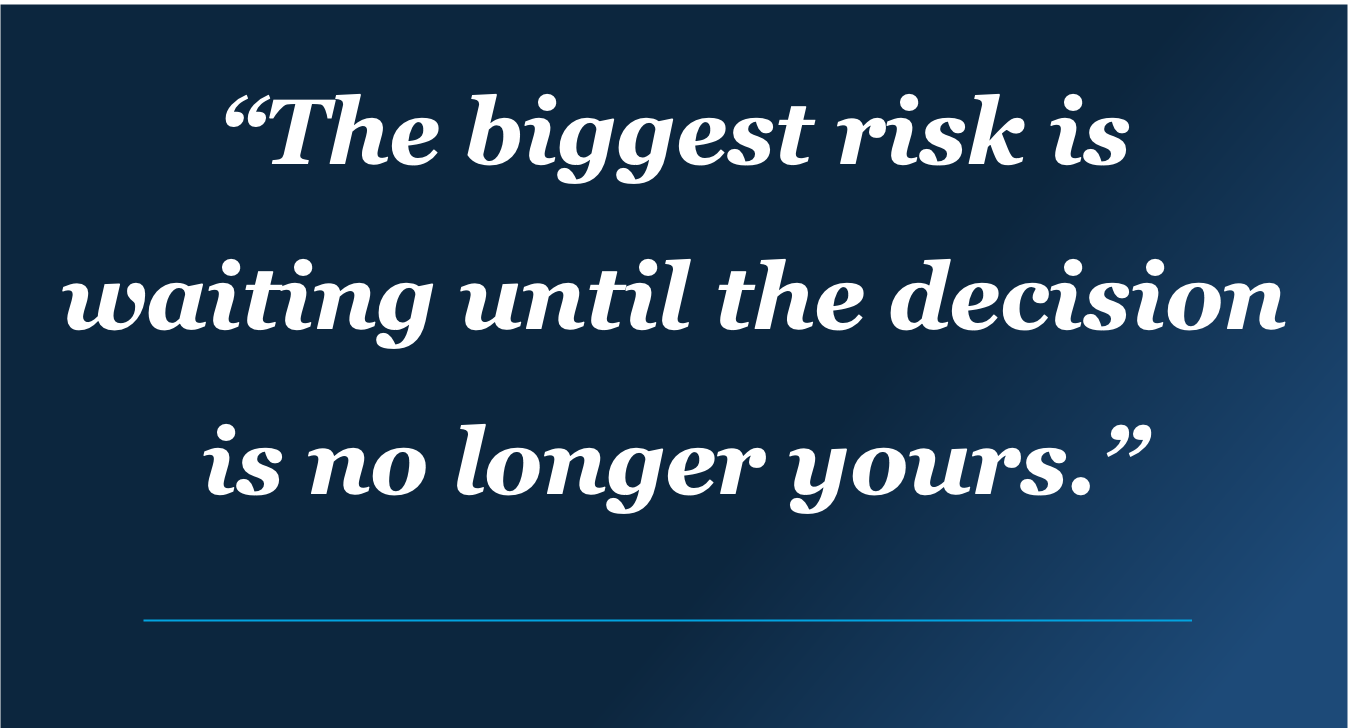
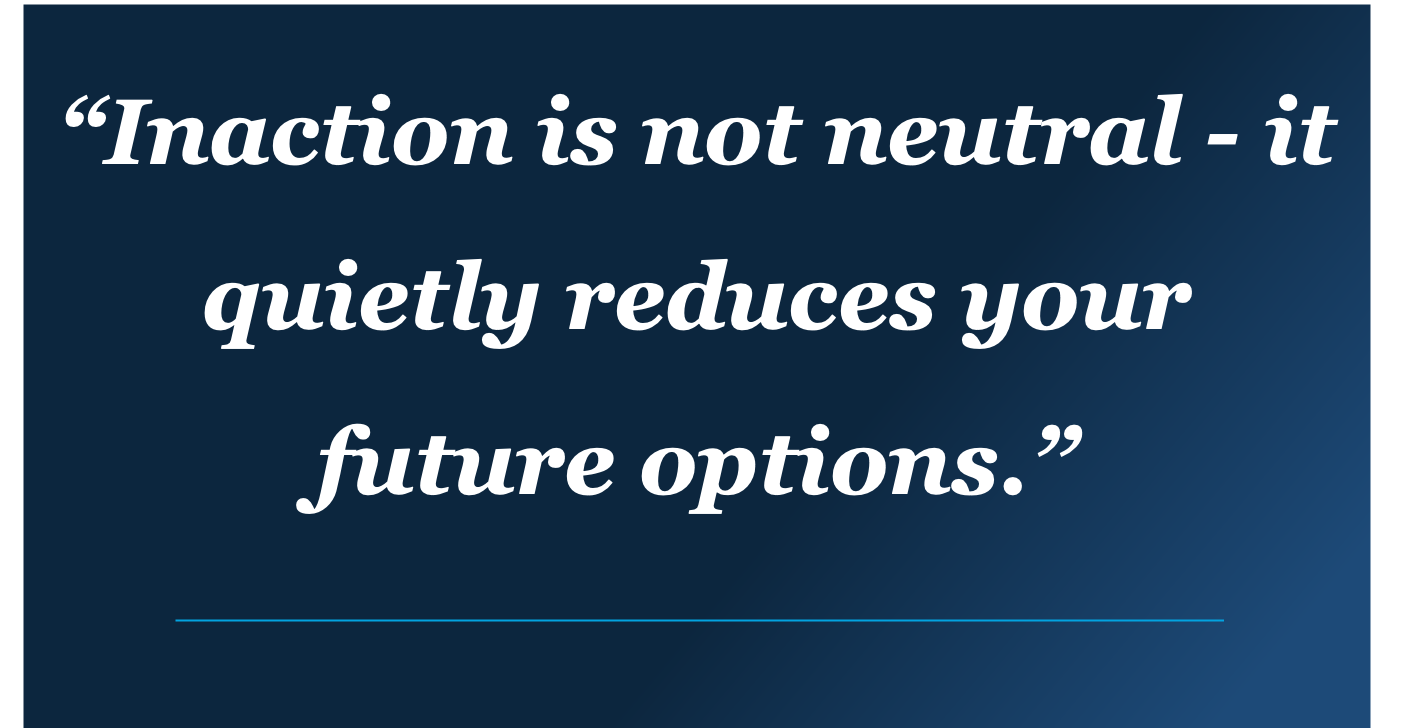
In practice, however, inaction is not neutral. It is a strategic choice, whether acknowledged or not. And for owners of sizeable, successful businesses, it is frequently the riskiest choice available.
This is not an argument for selling. Nor is it an argument for Private Equity. It is an argument for intentionality - for understanding that the absence of a strategy is itself a strategy, and often a fragile one.
Why “doing nothing” feels safe
Owners who have built substantial businesses tend to be rational, disciplined decision-makers. The instinct to avoid unnecessary disruption is understandable. Many founders have seen peers sell too early, regret the loss of independence, or struggle under new ownership.
“Doing nothing” offers several psychological comforts. It preserves control. It avoids difficult conversations. It allows the owner to focus on running the business rather than contemplating life after ownership. As long as performance remains strong, the choice appears justified.
But this perception relies on a flawed assumption: that the environment around the business will remain broadly stable.
The illusion of stability
Large privately owned businesses often look robust from the inside. Revenues are diversified, margins are acceptable, and the organisation has weathered past cycles. This history creates confidence that future challenges can be managed in the same way.
What this overlooks is that risk accumulates silently. It rarely announces itself in advance.
Markets evolve. Customer expectations change. Regulation tightens. Talent dynamics shift. Capital markets reprice risk. None of these developments require a crisis to be damaging. Over time, they can erode optionality without visibly harming day-to-day performance.
Owners who “do nothing” often discover - too late - that the conditions that once supported a premium outcome no longer exist.
Time is not neutral in ownership decisions
One of the most underappreciated dynamics in ownership strategy is the asymmetry of time. For the business, time can be an ally. For the owner, it is often not.
As founders age, personal risk tolerance changes - even if this is not consciously acknowledged. Health, energy, and appetite for long-term uncertainty evolve. Meanwhile, the business continues to demand reinvestment, leadership, and strategic renewal.
At some point, owners find themselves with less flexibility at precisely the moment when flexibility matters most. Options that were available five years earlier - partial exits, staged transactions, partner selection - have narrowed or disappeared.
The risk is not that the business declines dramatically. The risk is that choice disappears quietly.
Market cycles do not wait for readiness
Another reason inaction is dangerous is that exit conditions are cyclical, while owner readiness is personal.
Valuations, leverage availability, and investor appetite fluctuate. Windows open and close. They do not align neatly with personal timelines.
Owners who prepare early can choose whether to act when conditions are favourable. Owners who delay preparation are forced to react when conditions deteriorate—or when circumstances make action unavoidable.
History shows that many exits occur not because owners planned them, but because they were forced by events: illness, shareholder disputes, regulatory changes, competitive shocks, or unsolicited offers that create pressure.
At that point, negotiating power is already compromised.
The compounding risk of founder dependency
In many large privately owned businesses, the founder remains central - sometimes indispensable. This is often a source of pride and a testament to entrepreneurial skill. Over time, however, it becomes a structural risk.
When strategic decisions, key relationships, or organisational authority remain concentrated, the business becomes harder to transition. Investors, partners, and successors perceive continuity risk, even if performance is strong.
Founders who “do nothing” often assume this can be addressed later. In reality, reducing dependency takes time, intention, and credibility. Waiting until an exit is imminent is rarely effective.
What begins as strength gradually becomes friction.
Governance and professionalisation lag behind growth
Large privately owned businesses frequently outgrow their internal structures. Informal governance that worked at £20m revenue becomes strained at £100m or £200m. Reporting, decision-making, and accountability may lag behind scale.
As long as the owner remains actively involved, this imbalance can be masked. Once ownership transition becomes relevant, however, it is exposed immediately.
External investors and buyers assess not just performance, but how dependent performance is on the current owner’s presence. Businesses that have not evolved governance alongside growth are often discounted - not because they are poorly run, but because they are insufficiently institutionalised.
This is another way in which “doing nothing” accumulates cost invisibly.
The silent erosion of valuation drivers
Valuation is not only about EBITDA. It reflects predictability, scalability, resilience, and exitability.
Businesses that remain operationally strong but strategically static often see their valuation drivers erode subtly:
customer concentration increases,
margins depend on legacy pricing,
growth relies on mature markets,
talent retention becomes harder,
digital capabilities lag competitors.
None of these issues require immediate action. Together, they reduce attractiveness over time.
Owners who delay strategic reflection often discover that they are negotiating from a weaker position—not because the business declined, but because it failed to evolve.
Inaction often leads to reactive decisions
Perhaps the greatest risk of “doing nothing” is that it rarely remains an option indefinitely.
Eventually, something forces a decision: a health issue, a change in family circumstances, a regulatory shift, a competitive threat, or an unexpected inbound approach. At that point, the owner is no longer choosing freely.
Reactive exits are almost always inferior to planned ones. They involve compressed timelines, limited buyer universes, and reduced leverage in negotiations. Structure suffers. Culture protection weakens. Regret increases.
The irony is that many owners who resisted thinking about an exit to avoid pressure end up under far greater pressure later.
“Doing nothing” is not the same as “staying independent”
Many founders equate inaction with independence. In reality, independence is not preserved by default. It must be actively defended.
Remaining independent requires ongoing reinvestment, leadership renewal, and strategic adaptation. It requires clarity on succession, capital structure, and long-term direction.
Owners who do not articulate an independence strategy often drift into a position where independence becomes fragile - financially, operationally, or personally.
In that context, an eventual sale feels less like a choice and more like a concession.
Optionality is the true asset
For owners of large privately owned businesses, the most valuable asset is not the business itself. It is optionality.
Optionality means having credible alternatives:
to sell or not sell,
to take partial liquidity or none,
to partner or remain independent,
to choose timing rather than accept it.
Optionality requires preparation. It cannot be created overnight. And it is the first thing lost when owners default to inaction.
The purpose of thinking early is not to trigger a transaction. It is to preserve choice.
Why early reflection does not commit you to an exit
One of the most common objections we hear from founders is simple: “If I start thinking about this, it means I’m on a path to selling.” This is a false equivalence. Thinking strategically about ownership does not obligate action. On the contrary, it often reduces the likelihood of regretful action.
Owners who explore options early frequently decide not to sell. But they do so with clarity, confidence, and an understanding of what would need to change if circumstances evolve.
The difference is control.
The role of independent perspective
Owners who have built large businesses are deeply embedded in them. That proximity is both a strength and a limitation. It makes objective self-assessment difficult.
An independent, strategic perspective helps surface uncomfortable truths early - when they are still addressable. It allows owners to test assumptions, challenge narratives, and understand how external stakeholders would view the business under different scenarios.
This is not about marketing the business. It is about understanding it from the outside.
A reframing for owners and CEOs
The question is not: “Should I sell?” The more useful question is: “What risks am I accepting by not preparing?” For many owners, the answer is sobering.
A quiet call to action
If you are the owner or CEO of a large, privately owned business and find yourself increasingly thinking about the future - but reluctant to engage advisers because you are “not ready” - that hesitation is often the signal to start. Not to sell. Not to launch a process, but to establish, calmly and confidentially, what is possible and what is not.
Understanding your options early is not a commitment to change. It is insurance against being forced into it.
This article reflects Dyer Baade & Company’s experience advising founders and CEOs of leading privately owned businesses across Europe on ownership transitions, Private Equity partnerships, and long-term strategic options. If you would like to know more about your options, have a confidential conversation with a senior member of our team.